Thanks to Year 12 student Shahed Shehabi who wrote the following article.
Tacitus: The Political Hero
Dr Fiona Hill speaks about the current political climate
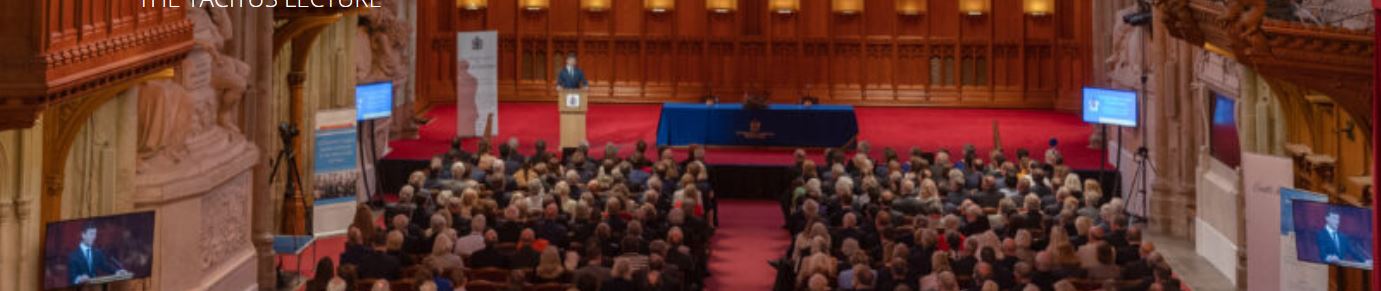
Thursday 26 marked the 39th Annual World Traders Tacitus lecture, a political lecture with the largest turnout within London. Aptly named after the Roman Senator, Publius Cornelius Tacitus, the lecture invites people from all backgrounds in order to voice their opinions on current world issues and explore what they expect to happen. For the last few years, the centre of focus has changed depending on the newest issue of the year, from AI and cybersecurity to the environment and climate change. It is only natural that this year was focused on politics and the constantly evolving events. In light of the current political climate, the World Traders felt it was important to invite Dr Fiona Hill to share her perspective. Her insights helped to deepen understanding of the issues at hand, encouraged others to learn more, and reminded us that even in uncertain times, these challenges will eventually pass.
Dr Fiona Hill, this year's guest lecturer, is an extremely decorated speaker who has worked as a presidential advisor for Bush, Obama and most recently, Trump. Currently, she is Chancellor of Durham University and a Defense Advisor to the UK government. Arguably, some of her most impactful work has been her efforts to educate audiences on the geopolitical and strategic dimensions of the Ukraine–Russia conflict, a field in which her expertise provides particularly valuable insight into the current political climate.
When beginning her lecture, Dr Hill joked that she found writing the speech difficult; once she had begun writing and drafting, something else would have happened. From the invasion of Venezuela, to the attacks on Iran, Dr Hill had found it difficult to explore the world as we knew it at that time. However, much like Dr Hill urged us to do, she adapted her lecture in order to speak about how change is imminent, and the fluid world right now is only a beginning. Using the metaphor of the Chinese New Year, Dr Hill stated that this was a year of change, of metamorphosis. She didn’t simply state that the world will always change, but also we must change as well in order to adapt to the world around us. Just as the Roman empire fell, so will the American empire, Dr Hill argued. Just as the Ottoman empire wasn’t permanent, neither will the American empire. Just as all things come to an end, so will the American empire.
Before the lecture began, young attendees were given the opportunity to gather in the cellars for an informal networking session with Dr Fiona Hill. This provided a rare chance to hear her perspectives in a more personal setting and to engage in discussion with both her and fellow students. It was not simply an opportunity to speak with a distinguished guest, but a valuable moment to reflect on our own views, challenge our assumptions, and consider how our understanding of global issues could be developed further. Many students, such as Sama Elgizoli had found the lecture to be “highly informative” and allowed them to broaden their own information on geopolitics.
Truly, the guest speaker for the 39th Annual Tacitus Lecture could not have been given to a better person; Dr Hill offered perception into the world that previously many, myself included, had not thought of and made sure to not brew anxiety and worries, which during times like these was necessary. She had switched from informative and stern, reminding us of the seriousness of the issues, to understanding and gentle, making sure to not arouse apprehension, offering a clear and powerful lecture with a message to remember: The challenges of today will not become the challenges of tomorrow.


